


Summary
Ads on the internet are more than annoying; they can also be a security risk
Wipr 2 is the ad blocker I recommend to my clients: it blocks ads, trackers, cookie banners, and more in Safari
It is an inexpensive one-time purchase, covers all your Apple devices, and requires no ongoing subscription
Works on iPhone, iPad, Mac, and Apple Vision Pro (requires iOS 17 or macOS Sonoma or newer)
Setup takes about two minutes, and after that you never have to touch it again
A client of mine came to a tutoring session frustrated that websites were loading slowly and that she kept getting bombarded with pop-ups asking her to accept cookies. She had no idea these things were connected, or that there was an inexpensive fix. I installed Wipr 2 on her Mac and her iPhone, and within a few minutes her browsing experience was transformed. Pages loaded faster, the cookie pop-ups disappeared, and the ads that had been cluttering her screen were gone.
If you use Safari and you don't have an ad blocker installed, this is one of the most impactful small changes you can make to your browsing experience.
App Store app
View current details in the App Store
Many ads are malicious or just downright misleading. Someone took out a “Print recipe” ad on Epicurious, tricking readers into buying an app when they think they are printing out a recipe from the site.
Why do Safari users need an ad blocker?
Most people think of ad blockers as a convenience: a way to clean up cluttered websites. And that's true. But the more important reason I recommend them to clients is safety.
Many online scams and malware infections don't come from sketchy websites; they come from ads served on legitimate ones. An ad network can be compromised without the website owner even knowing, and suddenly a trusted news site is showing ads that try to trick you into downloading something harmful or entering your Apple ID. I've seen this happen to clients who were doing nothing wrong.
Safari has some built-in protection against tracking, but it doesn't block ads. A dedicated ad blocker fills that gap. If you want more background on staying safe online, my post on reducing scam risks in Apple Mail covers some related ground.
What does Wipr 2 actually block?
Wipr 2 blocks more than ads. Here's what gets removed:
Display ads and banner ads: the images and boxes cluttering pages
Pop-ups: including the ones that open new tabs
Trackers: scripts that follow you around the web and build a profile of your browsing habits
Cookie consent banners: those "Accept all cookies" boxes that appear on almost every site
Crypto miners: hidden scripts that use your device's processing power to mine cryptocurrency without your knowledge
Annoyances: newsletter pop-ups, "download our app" prompts, video overlays, and sign-up nags
The blocklist updates automatically twice a week, so you don't have to do anything to stay current with new ad sources.
How much does Wipr 2 cost?
Wipr 2 is an inexpensive one-time purchase from the App Store. No subscription, no annual renewal. That single purchase covers Safari on all your Apple devices, and it's included in Family Sharing, so anyone in your iCloud Family gets it at no extra cost.
Does Wipr 2 work on iPhone, iPad, and Mac?
One purchase covers iPhone, iPad, Mac, and Apple Vision Pro.
One thing worth knowing: Wipr 2 requires iOS 17 or macOS Sonoma (14) or newer. If you have an older device that can't run those versions, Wipr 2 won't install. If you're not sure what software your device is running, check Settings > General > About on iPhone or the Apple menu > About This Mac on a Mac.
How do I set up Wipr 2?
Download Wipr 2 from the App Store: one purchase covers all your devices
Open the app and follow the on-screen instructions to enable it in Safari's settings
You'll need to repeat step 2 on each device (iPhone, iPad, Mac separately), but the purchase carries over automatically through your Apple ID
After that, there's nothing else to do. Wipr 2 runs quietly in the background and updates itself. You'll never see it again unless something stops working on a specific website.
What if a website stops working with Wipr 2 on?
Occasionally a website, especially a shopping site, breaks when ad blocking is active. Some sites detect blockers and refuse to load. When that happens, you can turn off blocking for that one site without disabling Wipr 2 everywhere.
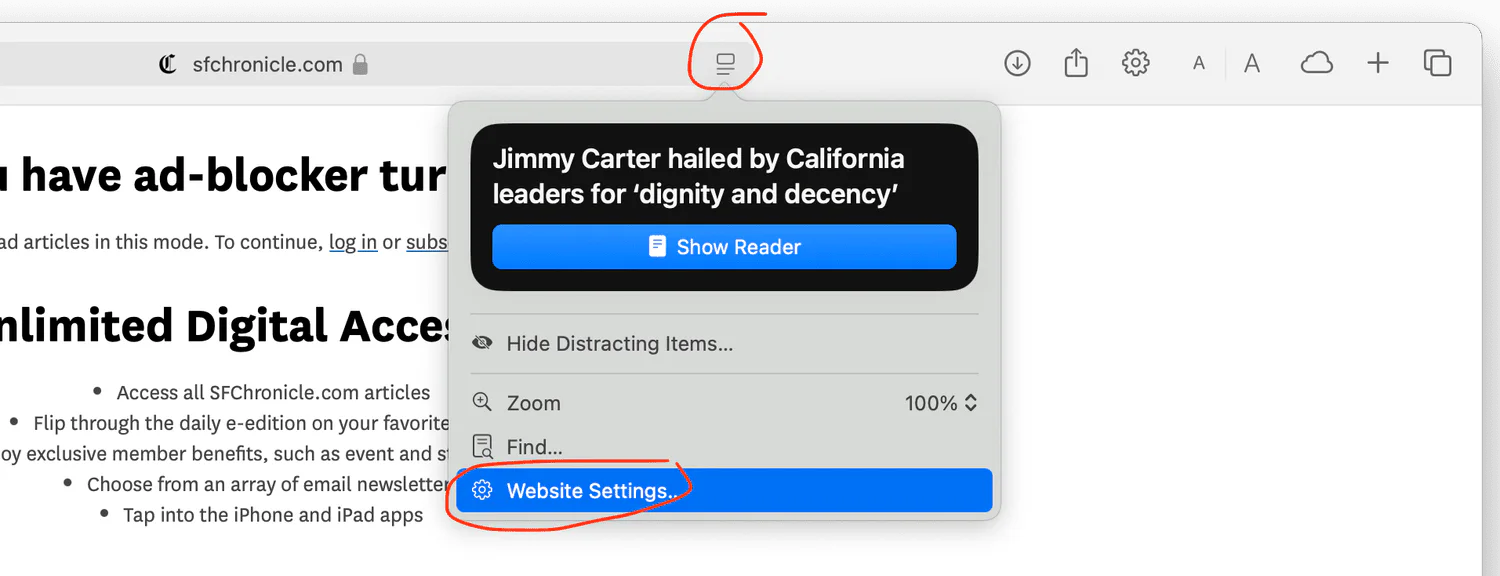
On Mac:
Open Safari and visit the site
Click the page settings icon in the address bar (it looks like two sliders), or go to the Safari menu
Choose Website Settings and uncheck Enable Content Blockers
On iPhone or iPad:
Open Safari and visit the site
Tap the page settings icon in the address bar
Tap the menu dots and toggle off Use Content Blockers
This only affects that specific site. Everywhere else stays protected.
What are the limits of Wipr 2?
Wipr 2 is not the right fit for everyone. Here's where it falls short:
It only works in Safari. If you use Chrome, Firefox, or another browser, Wipr 2 does nothing. It's Safari-only by design. If you're weighing whether Safari is the right browser for you in the first place, I have a separate guide on the best web browser for Mac.
It doesn't block ads in apps. If you watch YouTube in the YouTube app, ads will still appear. If you watch YouTube through Safari instead of the app, the ads disappear.
It has no customization. You can't pick and choose which types of content to block. It's all or nothing, by category. If you want fine-grained control, something like AdGuard is more flexible, though more complicated to set up and manage.
It doesn't block push notifications. If you've already agreed to receive notifications from a website, Wipr 2 won't stop those. Go to the Settings app > Notifications to adjust those.
For most of my clients, none of these limitations matter. They use Safari, they want fewer ads, and they don't want to manage settings. Wipr 2 is perfect for that.
What's new in Wipr 2?
For those who used the original Wipr, the second version was rebuilt from scratch and does significantly more. Beyond a much larger blocklist, the developer recently introduced a feature called Filtr (currently in beta) that would extend Wipr's blocking to all apps on your device, not only in Safari. This is made possible by a new technology in iOS 26 and macOS 26 called URL Filters. It won't be a VPN and won't have access to your network traffic. When it launches out of beta, it will be an in-app purchase that also covers Family Sharing.
I'll update this post when Filtr ships.
Common mistakes people make with Wipr 2
Forgetting to enable it on each device. Wipr 2 needs to be activated in Safari's settings separately on your iPhone, iPad, and Mac. The purchase is shared, but the enabling step is not. If you install it and nothing changes, this is almost certainly why.
Watching YouTube in the app and wondering why ads still appear. Wipr 2 works in Safari, not the YouTube app. Open youtube.com in Safari if you want ad-free YouTube.
Disabling it on a site and forgetting to turn it back on. It takes two taps to whitelist a site, which makes it tempting to do that and move on. That site stays unprotected until you go back and re-check Enable Content Blockers.
Expecting it to stop scam phone calls or emails. Wipr 2 only works in your browser. It has no effect on phone calls, text messages, or emails.
Treating it as a complete security solution. An ad blocker is one layer of protection, not a complete shield. Phishing emails, fake tech support calls, and other scams can still reach you through other channels. For more on staying safe online, the FAQ page covers questions I hear from clients all the time.
Key takeaways
Install Wipr 2 from the App Store with one purchase: one purchase covers all your Apple devices
Enable it in Safari's settings on each device after installing
If a site breaks, turn off content blocking for that site only, then turn it back on when you're done
For YouTube without ads, open youtube.com in Safari rather than the YouTube app
Wipr 2 requires iOS 17 or macOS Sonoma (14) or newer
If you're not sure whether Wipr 2 is right for you, or you want help getting it set up across your devices, I offer one-on-one tech tutoring sessions in San Francisco and Washington DC, and via Zoom for clients anywhere. Book a session here and we can take care of it together.