


Some links in this post are affiliate links. If you use them, I may earn a small commission at no extra cost to you.
Summary:
For most people, an SSD (solid-state drive) is the right choice: faster, smaller, and far more reliable than a traditional hard drive
Your backup drive should be at least twice the total storage capacity of your Mac, not just the amount you're currently using
My top pick is the Samsung T7; the SanDisk Extreme Portable SSD is the better value if Samsung prices are elevated
For very large storage needs (above 4 TB), a desktop hard drive is a practical compromise
Don't install the software that comes on the drive; macOS already includes Time Machine, which handles everything
If there's one thing I repeat to every client, it's this: back up your Mac. I've seen Time Machine save the day more times than I can count: botched software updates, accidental deletions, dead hard drives, computers that took an unexpected swim. The right external drive is all you need to get it running, and this post covers exactly what I recommend.
Drive comparison
All drives work with Mac Time Machine. SSDs recommended for most people.
| Drive | Buy | Notes | Type | Read / Write | Capacities |
|---|---|---|---|---|---|
| Samsung T7 Recommended View product on Amazon | Though it's my recommendation, prices have soared recently because of AI datacenter buildouts. | Portable SSD | 1,050 / 1,000 MB/s | 1, 2, 4 TB | |
| Samsung T9 View product on Amazon | Excellent if you want something a bit faster, but probably overkill for a backup. | Portable SSD | 2,000 / 1,950 MB/s | 1, 2, 4 TB | |
| SanDisk Extreme (old model) check_circle Runner-up View product on Amazon | With prices the way they are right now, this is the most reasonable choice. But if the prices of the Samsung drives fall and are comparable again, pick the Samsung T7 instead. | Portable SSD | 1,050 / 1,000 MB/s | 1, 2, 4, 8 TB | |
| SanDisk Extreme (new model) View product on Amazon | Excellent if you want something a bit faster, but probably overkill for a backup. | Portable SSD | 2,000 / 2,000 MB/s | 1, 2, 4 TB | |
| WD My Book Huge capacity View product on Amazon |
Additional sizes available on Amazon. |
A traditional rotating hard drive. Much cheaper at higher capacities, but at a cost of speed and reliability. Also, it requires a separate power adapter. | Desktop HDD | ~180 / ~180 MB/s | 6–26 TB |
Why do I need an external drive at all?
If you use iCloud, you might wonder whether a backup drive is even necessary. Here's the distinction: iCloud syncs your files, but it doesn't protect you from mistakes. If you delete something from your Mac, it gets deleted from iCloud too. If a software update goes sideways or your Mac fails mid-upgrade, iCloud won't restore your apps, settings, and system configuration.
Time Machine, on the other hand, keeps a running history of everything on your computer. If you drop your Mac in a lake, Time Machine can restore everything to a new Mac exactly as it was: applications, preferences, the works. It can save you hours of reinstalling and reconfiguring.
All you need to use it is an external drive.
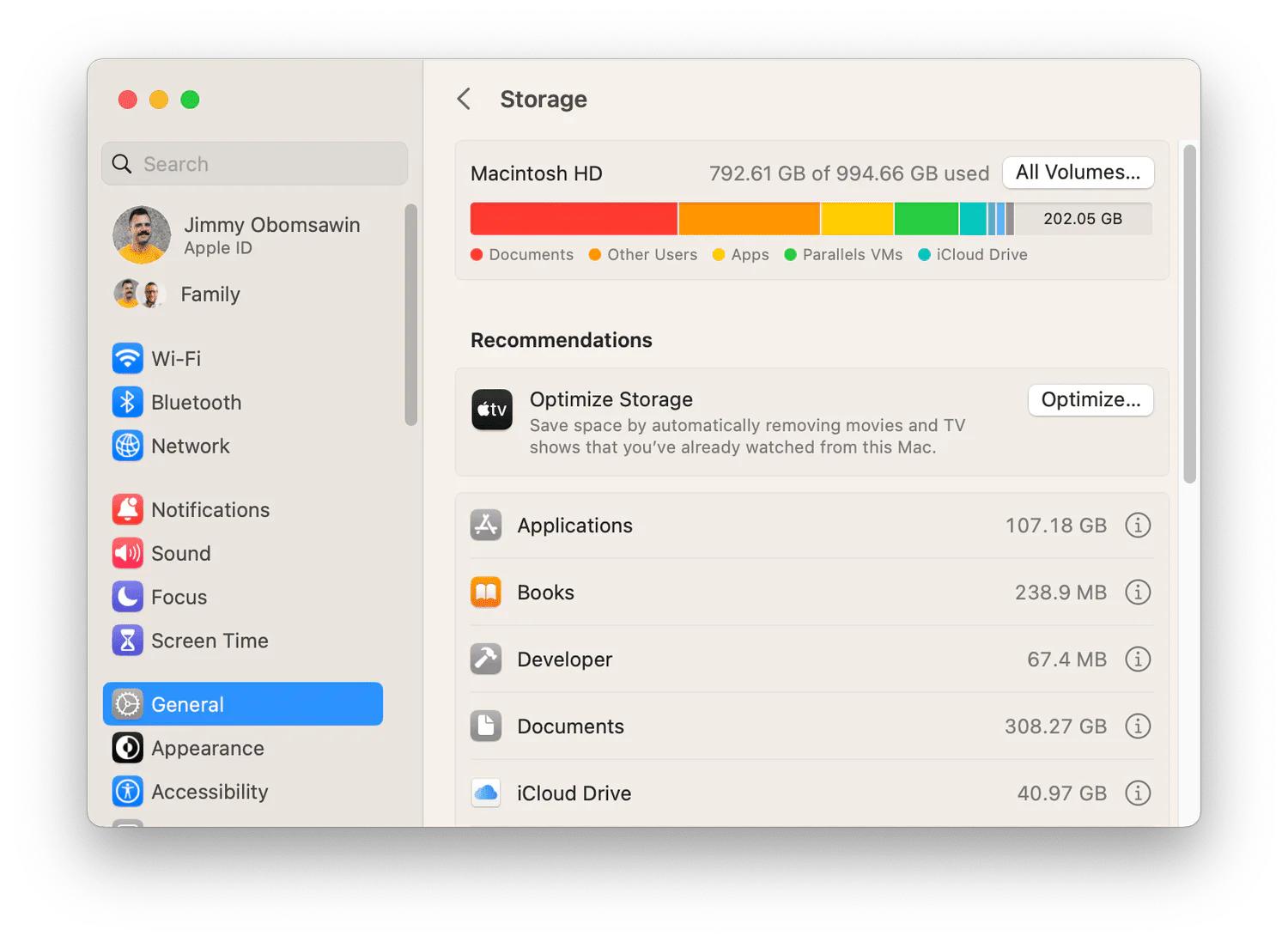
This screen shows that the computer has 994.66 GB total, which is roughly 1 TB. This means I would recommend a 2 TB backup drive.
How much storage do I need?
I recommend a drive that is at least twice the total storage capacity of your Mac, not just the amount you're currently using. Time Machine keeps multiple versions of your files over time, so it fills up faster than you'd expect, and you want room for your Mac to grow.
To check your Mac's total capacity: go to the Apple menu, then About This Mac, then look at the storage bar. The number shown as the total (not the amount used) is what you want to double.
For example, if your Mac has 512 GB of total storage, buy at least a 1 TB drive. If your Mac has 1 TB of storage, go with 2 TB.
Should I get an SSD or a hard drive?
For most people, I recommend an SSD (solid-state drive). SSDs have no moving parts, which makes them dramatically more reliable than traditional hard drives. They're also much smaller and much faster. The main tradeoff is cost: SSDs are more expensive per gigabyte, especially at higher capacities.
For anything up to 4 TB, an SSD is worth it. Above that, the cost starts to add up, and a desktop hard drive becomes a reasonable compromise, with the understanding that it is slower, less reliable, and requires a power cable.
What drive do I recommend?
My top pick is the Samsung T7. It's compact, reliable, comes in multiple capacities, and works with any Mac. That said, as of spring 2026, Samsung storage has been significantly more expensive than usual due to demand from AI data centers. Before you buy, check the current prices on both the Samsung T7 and the SanDisk Extreme Portable SSD. If the Samsung is notably more expensive, the SanDisk performs comparably and is a great alternative.
When shopping the SanDisk, you'll see both an "Old Model" and a "New Model" listed on Amazon. The new model is about twice as fast, but at a much higher cost. For a backup drive, the old model is perfectly fine.
If you want the fastest portable SSD available and don't mind paying more, the Samsung T9 transfers data at roughly twice the speed of the T7. That speed isn't necessary for a backup drive, but it's there if you want it.
What if I need a lot of storage?
If you need more than 4 TB and the cost of an SSD feels too high, a desktop hard drive is a practical option. The WD My Book is available in sizes ranging from 6 TB to 26 TB and connects via USB. Keep in mind that desktop drives are physically large, require their own power adapter, and are significantly slower and less reliable than SSDs.
WD My Book (6–26 TB) (Amazon)
How do I set up the drive?
Once you plug in your drive, macOS may ask if you want to use it with Time Machine. Say yes. If it doesn't ask automatically, go to System Settings, then General, then Time Machine, and add the drive there. The whole process takes just a few minutes, and it's one of the things I can walk through with a client over Zoom as easily as in person.
One important note: many of these drives come with backup software pre-installed on them. Don't use it. Time Machine is built into macOS and does the job well. You don't need anything extra.
For step-by-step setup instructions, I have a separate guide on setting up Time Machine.
What about common mistakes people make?
Buying based on used space instead of total capacity. Your Mac might only have 200 GB of files on it today, but if the drive itself holds 1 TB total, you need a 2 TB backup drive. Time Machine will eventually need that room.
Choosing a traditional hard drive to save money on a small backup. At the 1–2 TB size range, the price difference between an SSD and a hard drive is often small. The reliability difference is not. It's worth paying a bit more for the SSD at that size.
Installing the software that comes on the drive. It adds complexity without benefit. Skip it.
Buying the cheapest drive without checking reviews. Not all SSDs are equal. Stick with established brands: SanDisk, Samsung, and WD are all reliable choices.
When should you get help?
Setting up Time Machine is something most people can do on their own. But if you're not sure how much storage your Mac actually has, whether your existing drive is formatted correctly, or if you want to restore files from a backup you haven't touched before, those are situations where having someone walk through it with you can save a lot of frustration.
If you're in the San Francisco or Washington DC area, I offer in-person Mac tutoring sessions where we can set this up together, confirm your backups are running, and make sure you're covered. Zoom sessions are available anywhere. Book a session here.
Key takeaways
Check your Mac's total storage capacity in the Apple menu > About This Mac before buying a drive
Choose a drive at least twice that capacity — buy the next size up if you're close to a round number
Pick the Samsung T7 first; if prices are elevated, the SanDisk Extreme old model is the next best choice
When you plug in the drive, say yes when macOS asks to use it with Time Machine
Skip any software pre-installed on the drive and use Time Machine instead
After setup, confirm a backup has completed successfully before putting the drive away
Further reading


